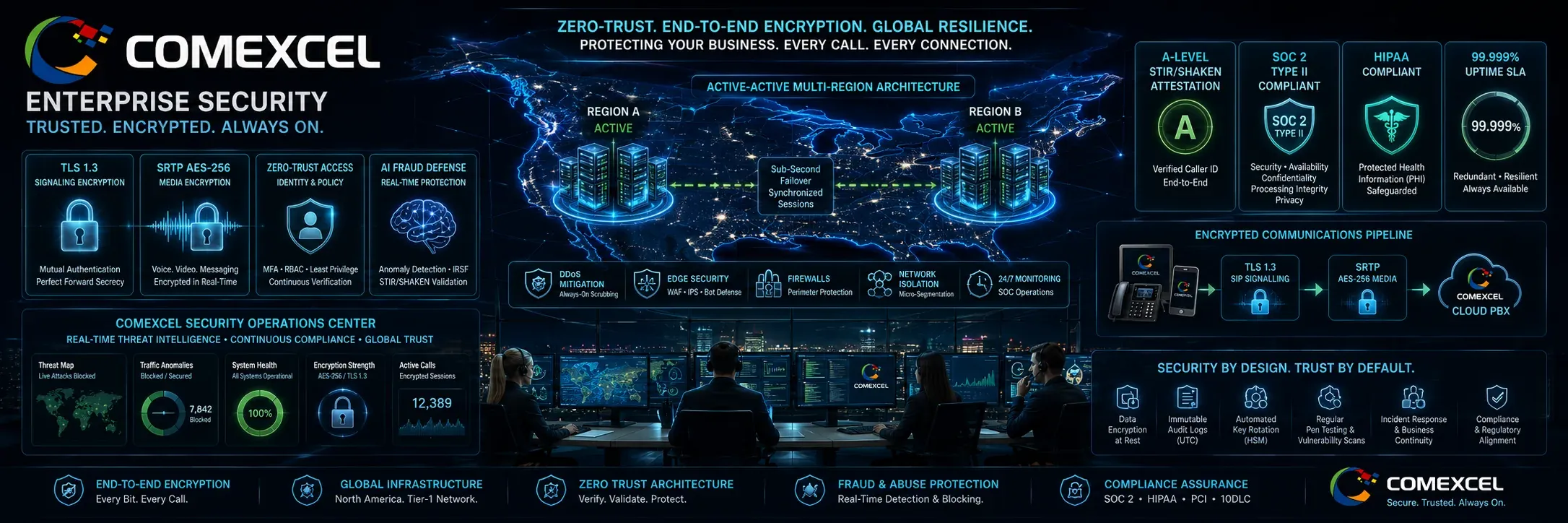
Ultrawide security dashboard illustrating COMEXCEL zero-trust architecture, TLS 1.3/SRTP encryption, active-active cloud nodes, and SOC-2 trust badges.

TRUST • ZERO-TRUST ARCHITECTURE • TLS 1.3/SRTP • SOC-2 ALIGNED

COMEXCEL Enterprise Security, Cloud Architecture & Trust Center

End-to-end media encryption, carrier-grade network resilience, zero-trust access controls, and strict compliance safeguards for mission-critical business communications.

COMEXCEL enterprise security delivers multi-layered cryptographic protection, geo-redundant network resilience, and strict access governance across our complete suite of Business VoIP & Cloud PBX Solutions. Modern business communication requires relentless defense against eavesdropping, fraud, unauthorized data interception, and operational downtime. Our carrier-grade infrastructure combines end-to-end Transport Layer Security (TLS 1.3) signaling, Secure Real-Time Transport Protocol (SRTP) media encryption, multi-tenant administrative isolation, and continuous threat monitoring to safeguard every call, SMS transmission, and WebRTC collaboration session. For statutory policies, master contracts, and regulatory filings, explore our centralized Legal, Regulatory & Compliance Center.

Cryptographic Transport & Media Encryption Architecture

COMEXCEL secures all signaling commands and live media streams using modern cryptographic cipher suites. Voice packets and signaling payloads are protected against eavesdropping, man-in-the-middle (MITM) attacks, and packet sniffing across public internet pathways. Dedicated Session Border Controllers (SBCs) authenticate each endpoint before establishing call sessions. This unified cryptographic foundation guarantees confidential voice and messaging across desktop IP phones, browser softphones, and mobile apps.

TLS 1.3 SIP Signaling Protection

Session Initiation Protocol (SIP) communication is wrapped in Transport Layer Security (TLS 1.3) with perfect forward secrecy (PFS). This prevents unauthorized eavesdropping, metadata tampering, and credential harvesting during call establishment. Every registered desktop IP phone, WebRTC softphone, and mobile client authenticates using unique cryptographic certificates.

End-to-End SRTP Voice & Video Media Encryption

Audio and video streams are encoded using Secure Real-Time Transport Protocol (SRTP) with AES-256 and AES-128 encryption standards. Media packets traverse the network fully encrypted from endpoint to switching cluster, preventing packet interception and unauthorized audio reconstruction across public internet paths.

Media Repository & Call Recording Vaults

Stored voicemails, call recordings, and message attachments are encrypted at rest using AES-256 ciphers. Decryption keys are managed through isolated Hardware Security Modules (HSMs) with strict key rotation policies, ensuring that only authenticated account administrators with verified permissions can access media archives.
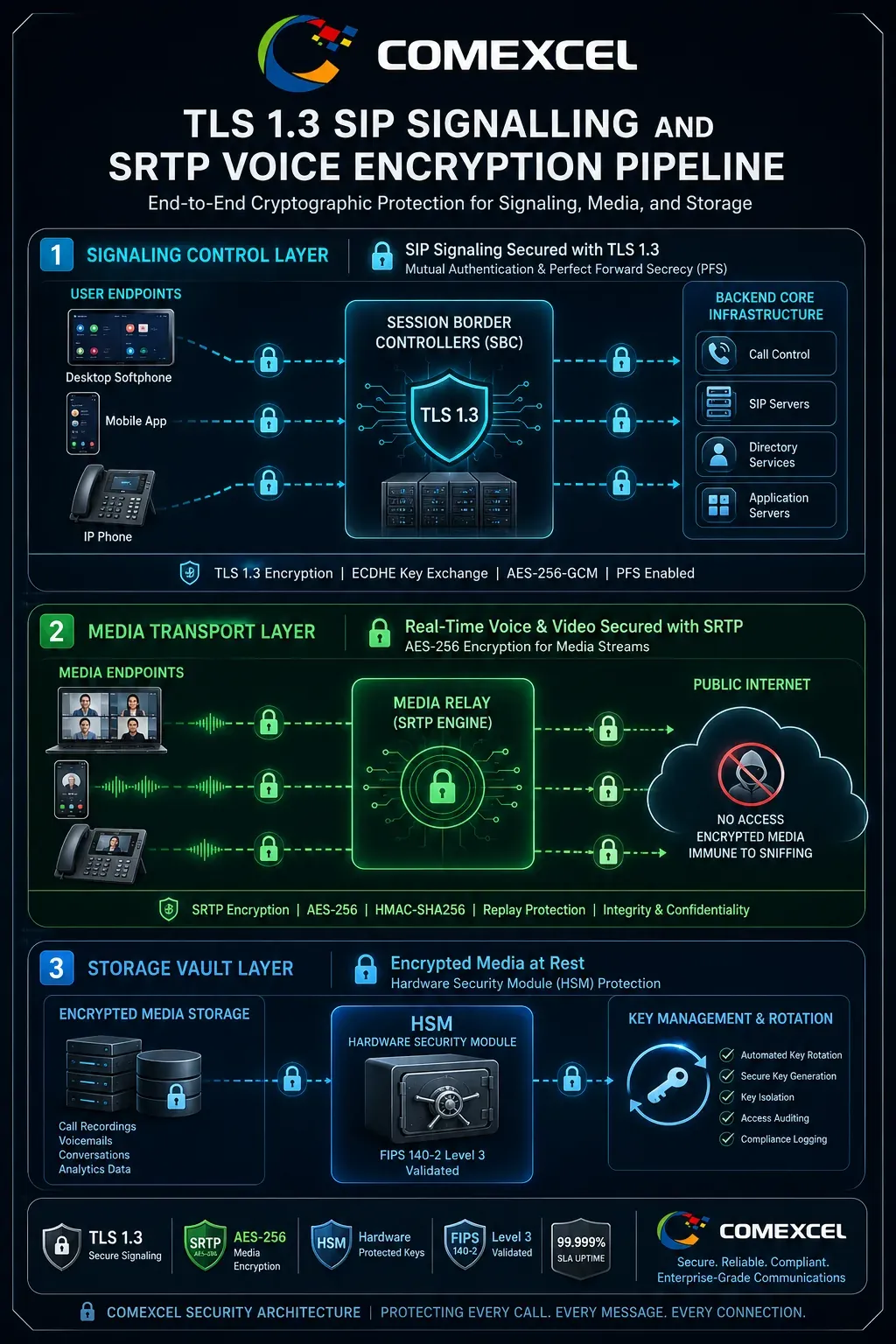
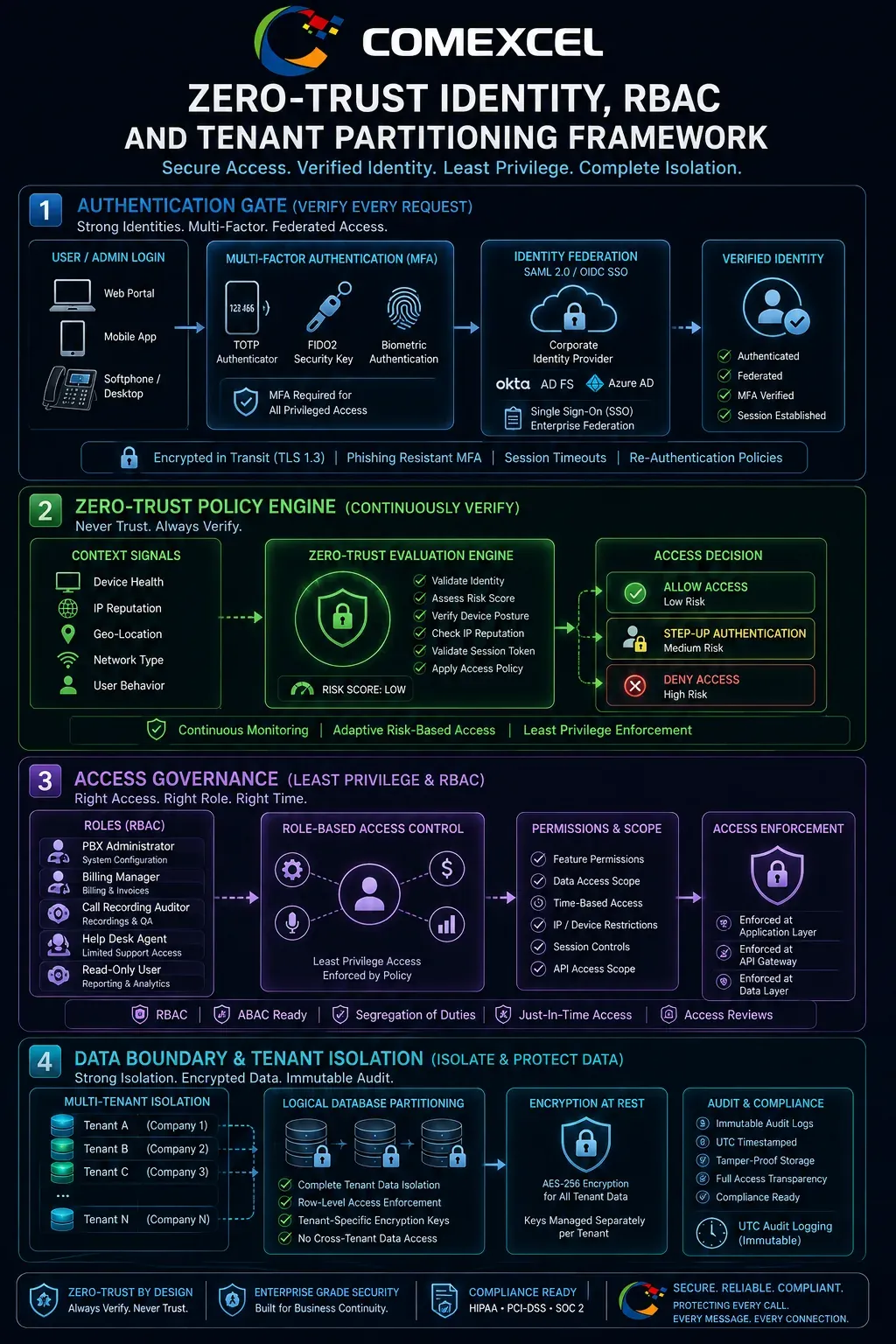
Vertical architecture diagram illustrating cryptographic isolation of SIP signaling (TLS 1.3) and voice media streams (SRTP/AES-256) from endpoints to HSM vaults.

Geo-Redundant Tier-1 Infrastructure & Network Resilience

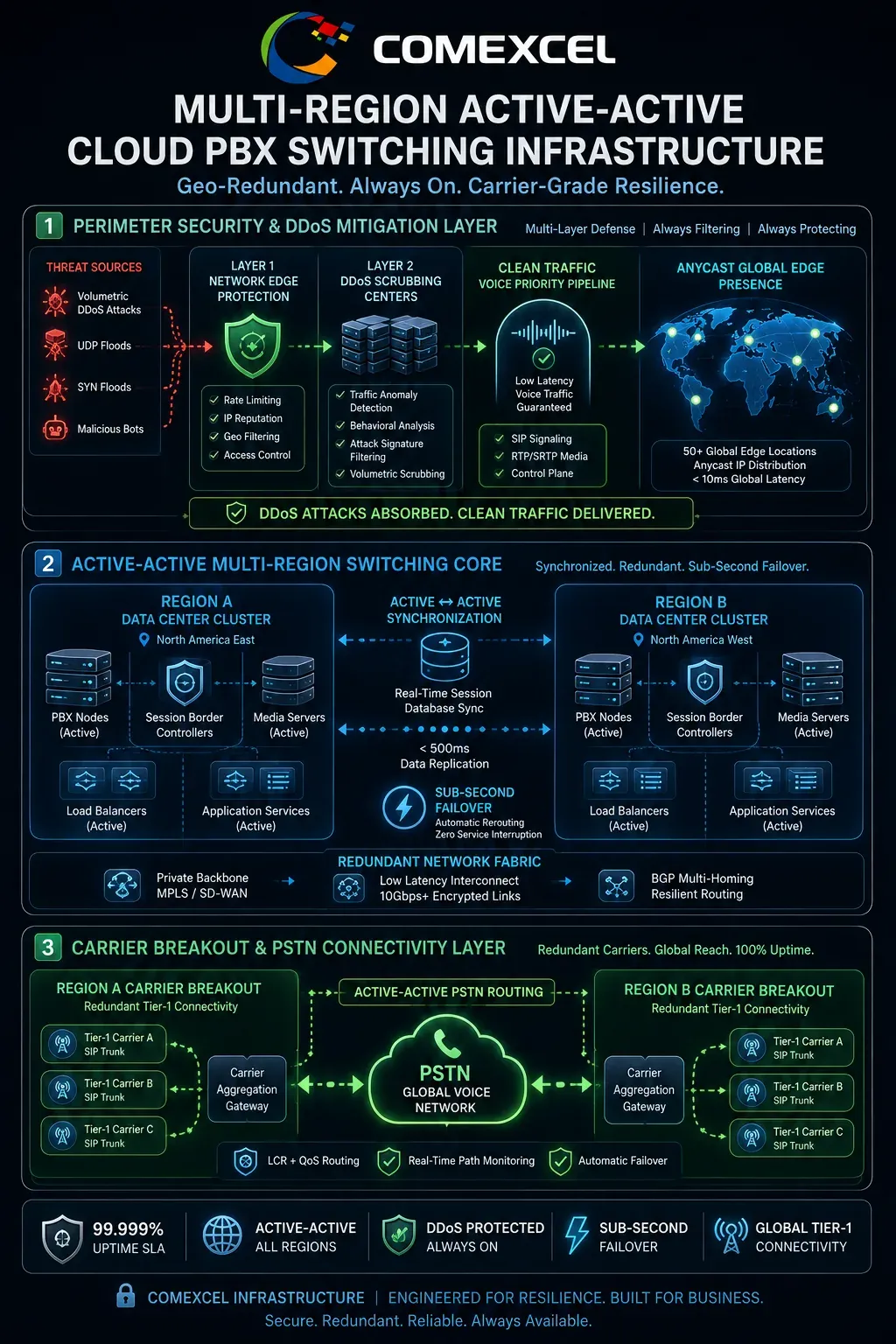
COMEXCEL switching clusters are deployed across redundant Tier-1 data centers positioned in diverse geographic availability zones. Our platform maintains automated failover routing, active-active call processing, and high-capacity network links to deliver 99.999% availability. Real-time carrier route monitoring reroutes voice traffic around upstream fiber cuts and carrier outages without dropping live calls. Continuous DDoS mitigation filters protect our cloud PBX infrastructure from volumetric floods and protocol attacks.

Active-Active Multi-Region Switching Architecture

Voice switching nodes are distributed across geographically isolated Tier-1 carrier facilities with synchronized session databases. If a regional data center encounters an infrastructure event, active call processing automatically balances to healthy nodes across secondary availability zones without service disruption.

Multi-Layered DDoS Defense & Traffic Scrubbing

Automated DDoS mitigation systems monitor traffic at the network edge to identify and scrub volumetric floods, SIP UDP floods, and SYN attacks. Clean voice traffic is prioritized through dedicated low-latency pipelines, maintaining pristine jitter, latency, and packet loss metrics during network incidents.

Carrier Redundancy & Dynamic Failover Routing

Direct interconnects with Tier-1 telecommunications carriers provide redundant PSTN breakout paths across North America. Dynamic route failover ensures that outbound and inbound calls automatically traverse alternative carrier routes if an upstream provider experiences circuit degradation.

Architecture diagram illustrating active-active multi-region failover, edge DDoS mitigation pipelines, and redundant Tier-1 carrier PSTN breakout paths.

Zero-Trust Access Control & Multi-Tenant Identity Governance

Our cloud PBX environment is engineered on zero-trust principles, validating every user, device, and API request before granting system access. Granular Role-Based Access Control (RBAC) restricts administrative privileges, call recording downloads, and billing management to verified personnel. Multi-Factor Authentication (MFA) and Single Sign-On (SSO) integration prevent unauthorized credential abuse across mobile, desktop, and web portals. Comprehensive audit logging records every administrative change to support security monitoring and compliance tracking.

Multi-Factor Authentication (MFA) & Enterprise SSO

All administrator and end-user access points enforce Multi-Factor Authentication (MFA) using time-based one-time passwords (TOTP) or hardware security keys. Enterprise accounts seamlessly integrate with corporate Identity Providers (IdPs) via SAML 2.0 and OpenID Connect (OIDC) for centralized identity lifecycle management.

Role-Based Access Control (RBAC) & Administrative Isolation

Granular permission sets separate call management, billing operations, call recording access, and user provisioning. Multi-tenant database partitioning ensures that customer configurations, extension directories, and communications metadata remain completely isolated between organizations.

Immutable Audit Trails & Activity Telemetry

Every administrative modification, user login event, call recording export, and permission update generates a tamper-evident audit record. System logs capture IP addresses, timestamps in UTC, and user agent identifiers to support enterprise security evaluations and incident response workflows.

Diagram showing Multi-Factor Authentication (MFA), SAML 2.0 SSO identity federation, role-based access controls, and multi-tenant database isolation.

Telecommunications Fraud Defense & Network Integrity Controls

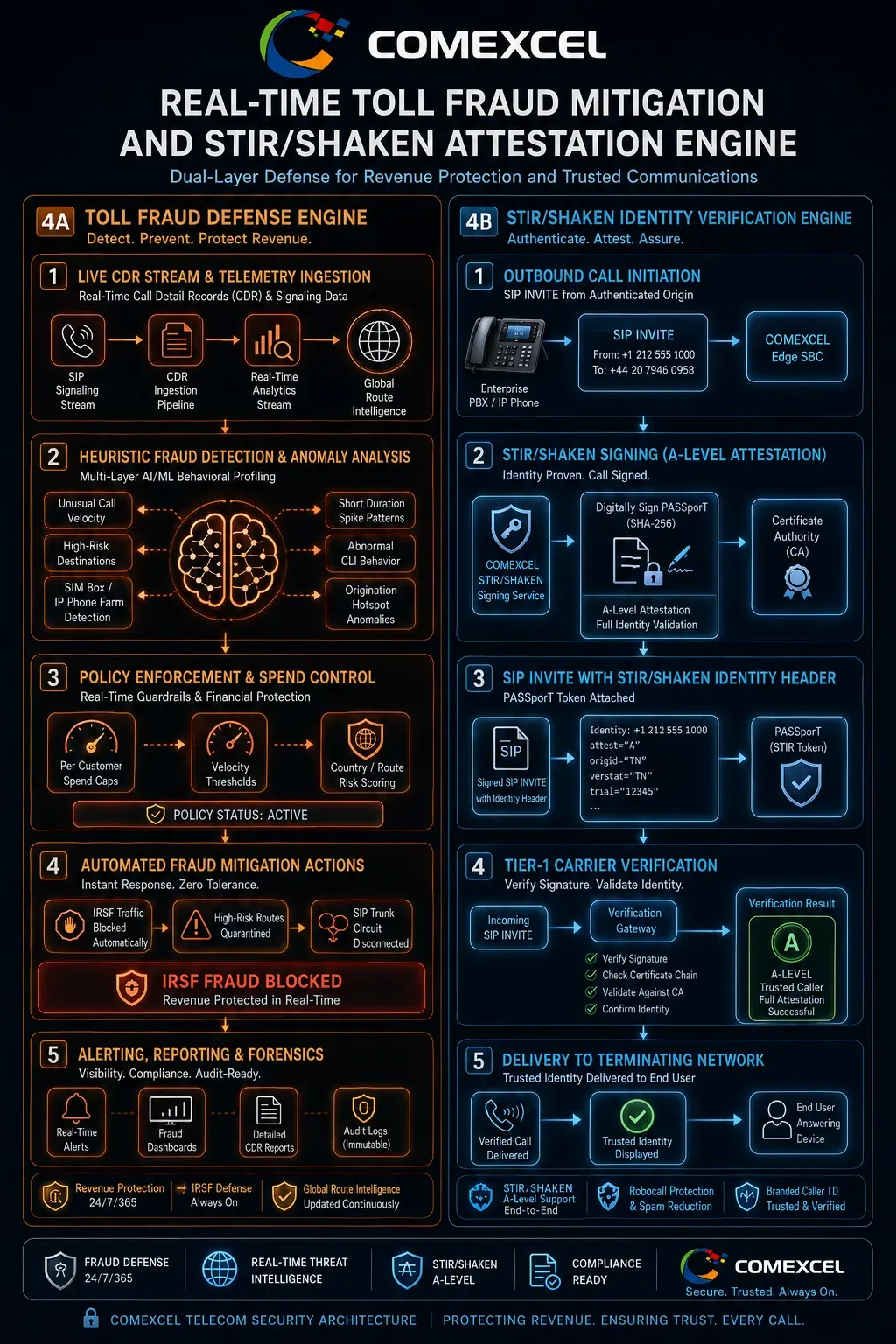
Unmonitored VoIP networks face ongoing threats from international revenue share fraud (IRSF), brute-force SIP attacks, and automated robocall campaigns. COMEXCEL integrates real-time automated fraud detection algorithms that detect anomalous call volume, irregular destination spikes, and off-hours traffic anomalies. Native STIR/SHAKEN cryptographic caller ID authentication stops spoofed calling attempts from abusing your business numbers. Continuous monitoring ensures your phone system remains secure from unauthorized long-distance exploitation.

Real-Time International Toll Fraud & IRSF Prevention

Automated fraud detection systems monitor calling patterns in real time to detect high-velocity outbound spikes, unauthorized international destinations, and abnormal calling velocity. Accounts can establish country whitelisting, daily spend caps, and instant automated threshold cutoffs to prevent financial exposure.

Cryptographic STIR/SHAKEN Caller ID Authentication

COMEXCEL natively signs outbound voice traffic with cryptographic STIR/SHAKEN digital certificates, providing Tier-1 carrier verification and “A-Level” attestation. This prevents spoofed calls from hijacking your business identity and ensures your legitimate calls reach recipients with verified caller ID tags.

Automated SIP Brute-Force & Rate-Limiting Defenses

Edge firewalls and Session Border Controllers enforce dynamic rate limiting and behavioral analysis against registration scanning. Automated IP blacklisting immediately blocks rogue entities attempting password brute-forcing or SIP invite flooding.

Flowchart illustrating automated international revenue share fraud (IRSF) detection, spend caps, and cryptographic STIR/SHAKEN caller ID authentication.

Enterprise Security ROI, Risk Mitigation & TCO Protection

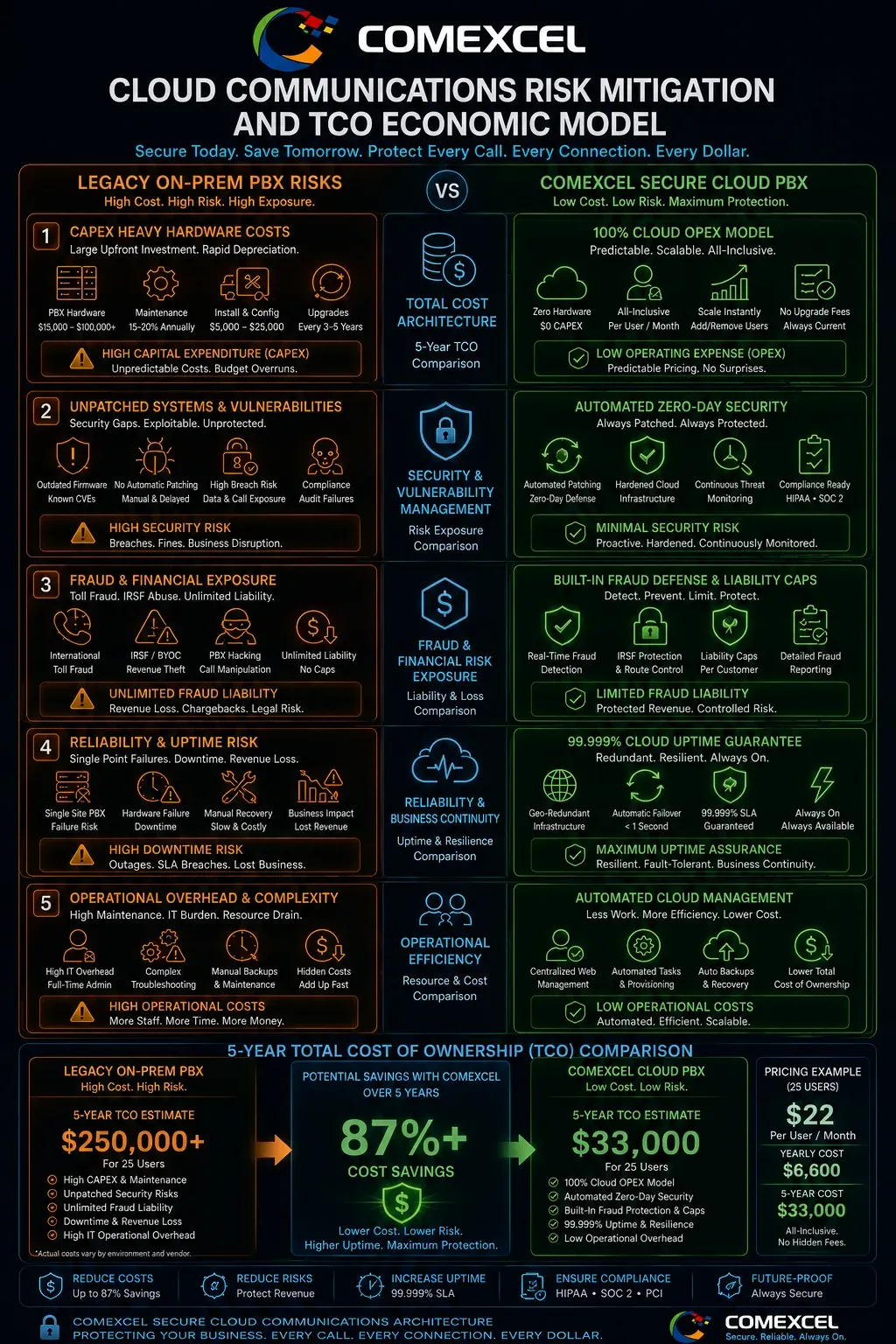
Investing in enterprise-grade cloud telecommunications security provides measurable financial returns by eliminating catastrophic toll fraud liabilities and data breach risks. Outdated on-premise PBX hardware exposes enterprises to expensive PBX hacking, unpatched firmware vulnerabilities, and costly dedicated maintenance contracts. Migrating to COMEXCEL’s secure cloud communications platform eliminates hardware capital expenditures while protecting your bottom line. Robust security controls minimize operational downtime, lower insurance premiums, and protect brand reputation.

Elimination of On-Premise PBX Vulnerabilities & Hardware CAPEX

Legacy on-premise PBX systems require constant hardware maintenance, dedicated server rooms, and expensive security patch deployments. COMEXCEL eliminates on-premise hardware risks by delivering fully managed cloud communications with automated security updates, reducing total cost of ownership (TCO).

Financial Protection Against Toll Fraud & IRSF Exploits

Unprotected business phone systems often face overnight toll fraud attacks exceeding tens of thousands of dollars in carrier charges. Our automated velocity filters, spend limits, and real-time fraud mitigation protect organizations from unexpected billing liabilities and carrier disputes.

Business Continuity, Uptime Assurance & Brand Protection

Communications downtime directly damages customer trust, disrupts sales operations, and triggers substantial financial losses. Geo-redundant cloud infrastructure and active-active failover preserve business continuity, protecting customer relationships and enterprise revenue streams.

Comparative economic matrix contrasting vulnerable on-premise PBX hardware risks against secure, managed cloud PBX total cost of ownership savings.

Enterprise Security, Architecture & Trust Frequently Asked Questions (FAQ)

How does COMEXCEL protect voice traffic against interception and eavesdropping?

COMEXCEL secures all signaling commands and live media streams using Transport Layer Security (TLS 1.3) for SIP signaling and Secure Real-Time Transport Protocol (SRTP) with AES-256 encryption for media packets. This ensures voice calls, video sessions, and messaging payloads remain fully protected against packet sniffing and man-in-the-middle (MITM) attacks across public internet connections.

Is COMEXCEL cloud communications infrastructure SOC 2 aligned?

Yes. COMEXCEL infrastructure, switching clusters, and data centers follow strict SOC 2 Type II operational trust principles covering security, availability, and confidentiality. Enterprise procurement and SecOps teams can request SOC 2 audit summaries and architectural whitepapers under a mutual non-disclosure agreement by contacting [email protected].

How does COMEXCEL maintain 99.999% uptime and high availability?

Our cloud PBX switching platform is deployed in active-active configurations across geographically diverse, Tier-1 carrier facilities. If an unexpected regional outage or network fiber degradation occurs, voice traffic and active registration sessions automatically balance to redundant secondary availability zones without dropping live calls.

How are stored call recordings, voicemails, and media archives secured?

All stored media files, call recordings, and voicemail attachments are encrypted at rest using AES-256 encryption. Decryption keys are managed through isolated Hardware Security Modules (HSMs) with automated rotation schedules, ensuring media vaults are accessible solely by authorized administrators with verified permissions.

What defenses does COMEXCEL use against international toll fraud and IRSF?

COMEXCEL implements real-time automated fraud detection systems that analyze calling velocity, detect abnormal outbound volume spikes, and flag uncharacteristic destination attempts. Account administrators can configure country destination whitelisting, daily spend ceilings, and automated balance cutoffs to eliminate unexpected financial liability.

How does COMEXCEL support STIR/SHAKEN caller ID authentication?

COMEXCEL cryptographically signs outbound voice traffic with digital certificates through direct Tier-1 carrier integrations, providing “A-Level” attestation. This ensures your legitimate business phone numbers are authenticated across public telephone networks and protected against illegal caller ID spoofing and spam tagging.

Does COMEXCEL enforce Multi-Factor Authentication (MFA) and Single Sign-On (SSO)?

Yes. Account portals enforce Multi-Factor Authentication (MFA) via time-based one-time passwords (TOTP) and hardware security tokens. Enterprise organizations can integrate corporate Identity Providers (IdPs) via SAML 2.0 and OpenID Connect (OIDC) to centralize user provisioning and enforce zero-trust access policies.

How does COMEXCEL ensure tenant isolation in a multi-tenant cloud environment?

COMEXCEL utilizes strict logical partitioning at the database and application layers. Customer configuration files, user credentials, call routing rules, and communications metadata are isolated so that no organization can access or view another tenant’s data or network traffic.

How does COMEXCEL protect against Distributed Denial of Service (DDoS) attacks?

Our network perimeter features multi-layered DDoS mitigation systems and Session Border Controllers (SBCs) that detect and filter volumetric UDP floods, SIP registration scans, and SYN attacks. Legitimate voice traffic is routed through dedicated low-latency scrubbing pipelines to preserve audio quality and call completion rates.

How does COMEXCEL support HIPAA Security Rule compliance for healthcare providers?

COMEXCEL provides encrypted voice streams (TLS 1.3/SRTP), AES-256 encrypted media repositories, role-based access controls, and tamper-evident audit logs. We sign standard Business Associate Agreements (BAAs) with qualifying healthcare organizations to support their regulatory requirements.

Where can enterprise teams find binding legal contracts and regulatory policies?

All master subscription terms, Acceptable Use Policies, E911 emergency dialing disclosures, and data retention schedules are centrally published in our Legal, Regulatory & Compliance Center.

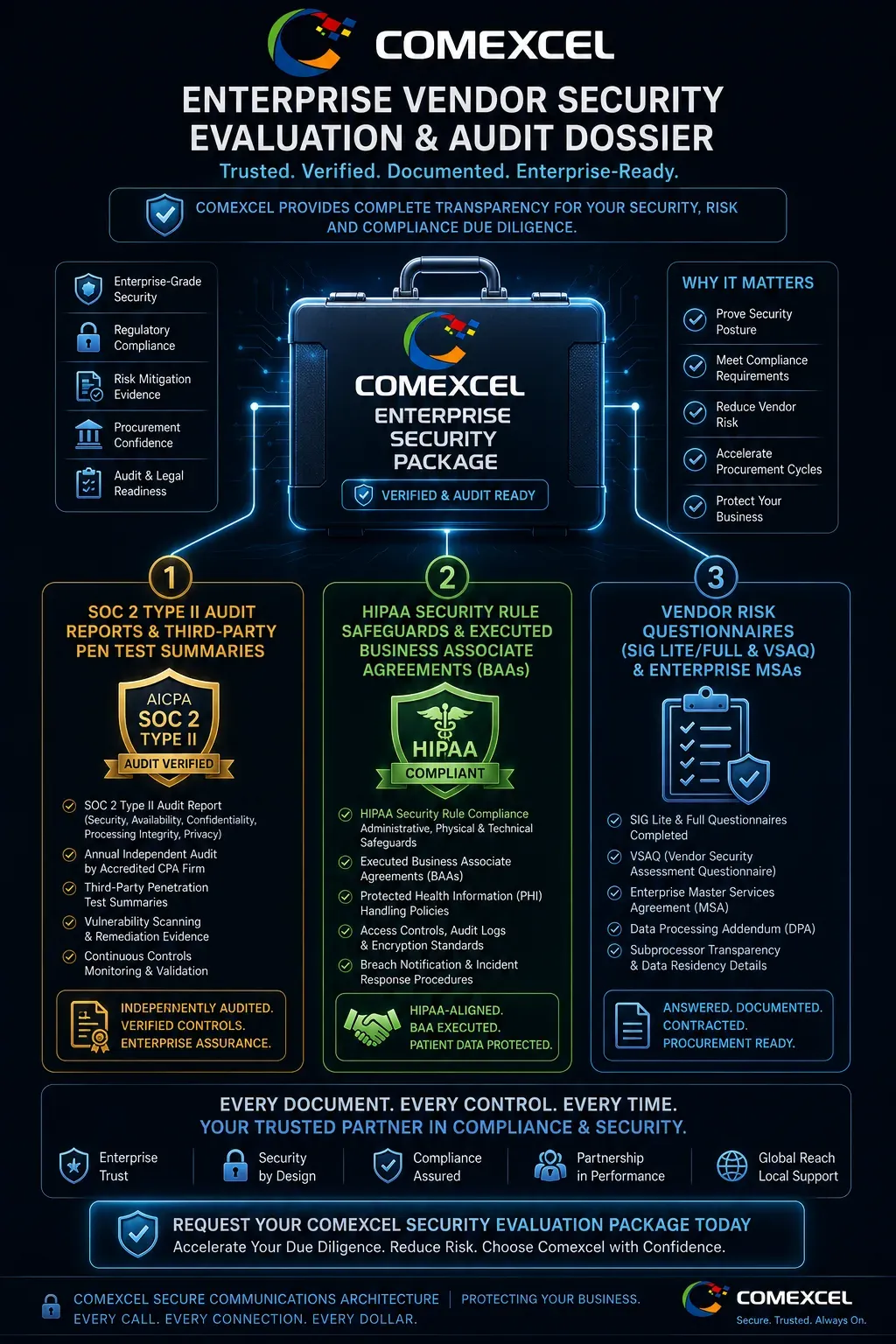
Graphic representation of the COMEXCEL enterprise security assessment package, including SOC 2 Type II reports, penetration testing summaries, and signed BAAs.

Enterprise Security Assessment, Procurement & Vendor Due Diligence

COMEXCEL supports enterprise IT leaders, Chief Information Security Officers (CISOs), and procurement teams conducting vendor risk evaluations. Our cloud infrastructure is engineered to satisfy the rigorous technical requirements of Fortune 500 enterprises, regulated healthcare networks, and financial institutions. We provide verified security documentation, architectural whitepapers, and SOC 2 Type II assessment reports under mutual non-disclosure agreements. Our dedicated security and compliance engineering teams are available to assist with custom audit requests and technical inquiries.

Enterprise Security Package & SOC 2 Requests

Enterprise procurement teams can request our comprehensive security assessment dossier, including SOC 2 Type II audit summaries and network penetration test results. Our security team reviews and completes enterprise vendor risk assessment questionnaires (VSAQs) and SIG Lite/Full assessments. Direct your documentation requests directly to our security engineering team at [email protected].

Regulatory Compliance & BAA Execution

Healthcare providers, financial institutions, and regulated enterprises can execute binding Business Associate Agreements (BAAs) and custom data protection terms. Our compliance specialists ensure all voice and messaging configurations strictly adhere to HIPAA Security Rules and statutory privacy mandates. Submit compliance inquiries and custom data protection requests directly to [email protected].

Contractual Terms & Legal Hub Access

Review the complete framework of contractual agreements, Acceptable Use Policies, E911 emergency services disclosures, and data retention timetables governing our platform. All customer master service agreements and carrier-grade regulatory filings are published transparently for legal counsel review. Visit our centralized Legal, Regulatory & Compliance Center to explore our complete document registry.