Effective Date: September 10, 2026 | Last Updated: September 10, 2026
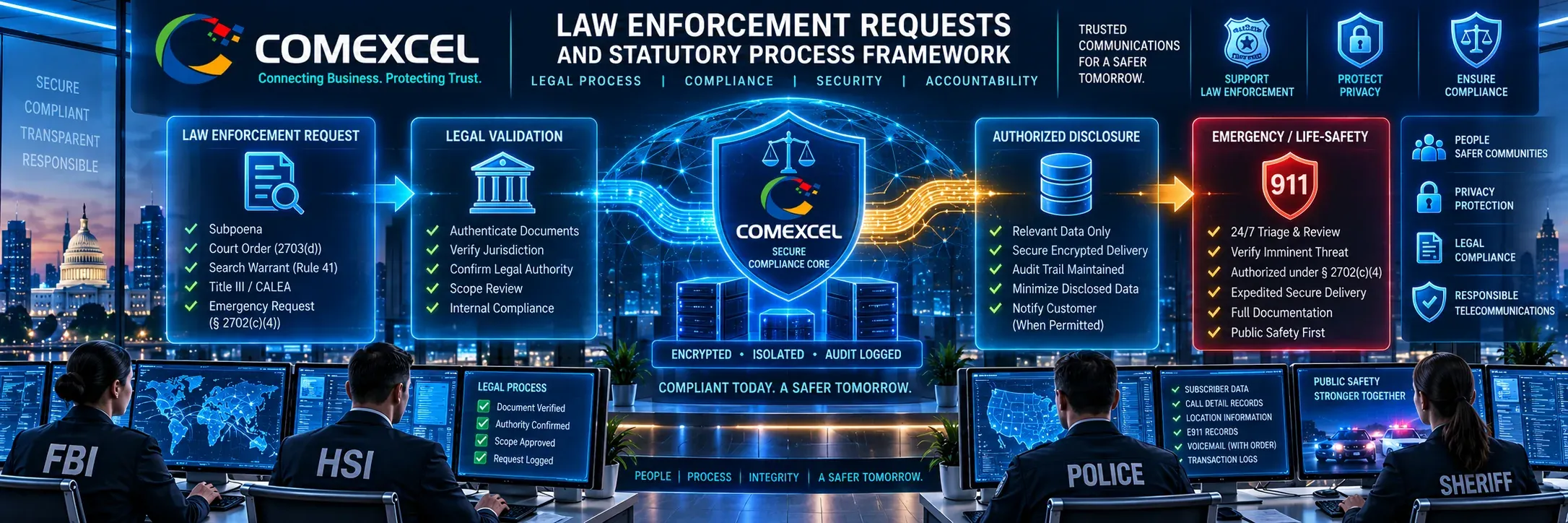
COMEXCEL Law Enforcement Request and Legal Process Guidelines establish the formal statutory procedures, verification standards, and operational protocols governing external information requests. COMEXCEL is committed to protecting customer privacy across our Business VoIP & Cloud PBX Solutions while maintaining strict compliance with applicable federal, state, and international laws. These guidelines provide government agencies, law enforcement authorities, and authorized civil litigants with the mandatory prerequisites required to request subscriber identity, Call Detail Records (CDRs), messaging metadata, or lawful surveillance assistance.
All information requests are evaluated on a case-by-case basis under the Electronic Communications Privacy Act (ECPA, 18 U.S.C. § 2701 et seq.), the Stored Communications Act (SCA), the Communications Assistance for Law Enforcement Act (CALEA, 47 U.S.C. § 1001 et seq.), and other applicable statutory frameworks.
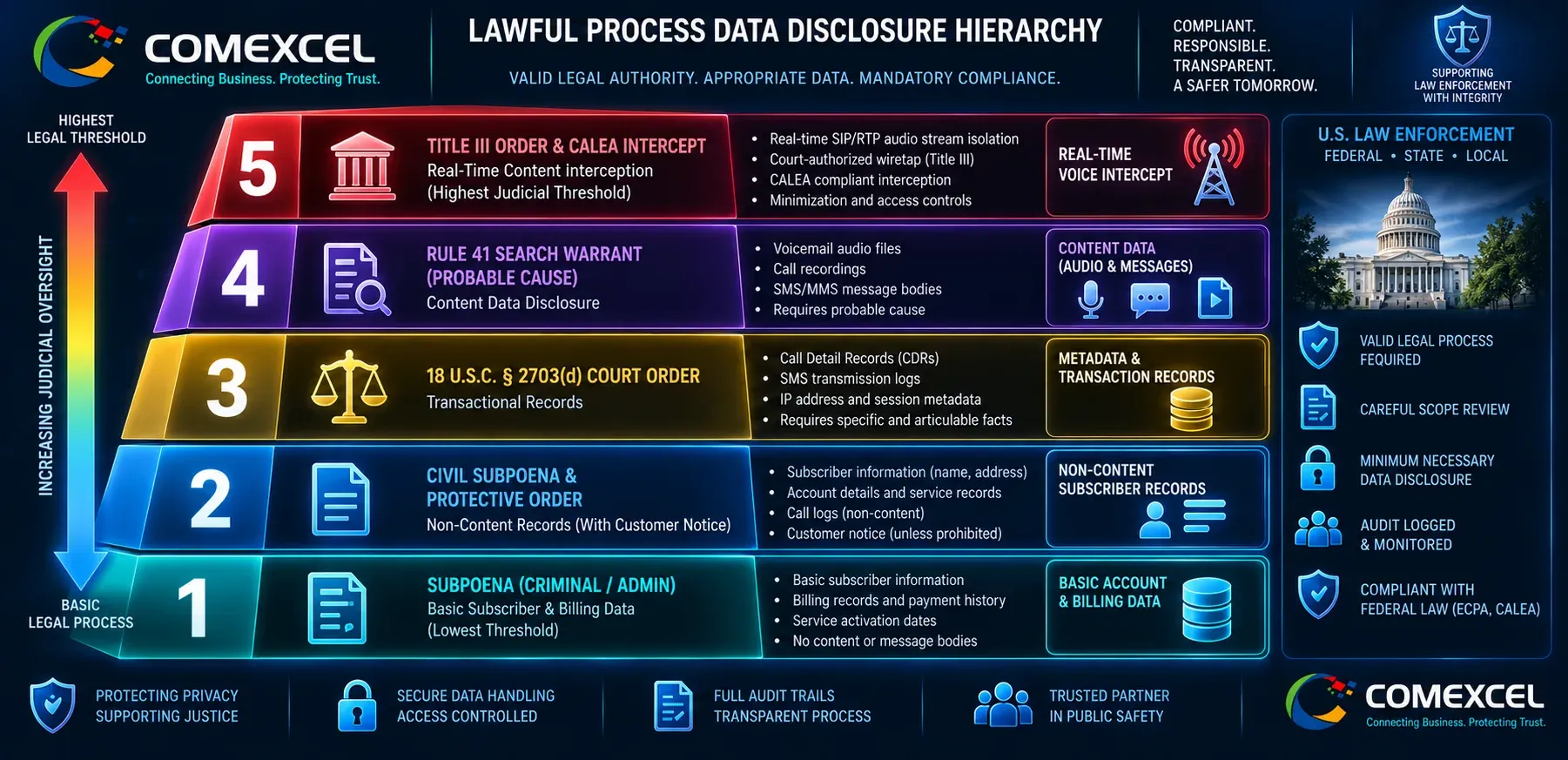
Legal Process Requirements Matrix
As part of our centralized COMEXCEL Legal & Compliance Hub, we enforce rigorous evidentiary standards before processing any external inquiry. COMEXCEL will not disclose non-public customer records, stored communications, or real-time network traffic without valid, enforceable legal documentation properly served upon our registered statutory agents:
| Legal Process Type | Legal Authority Standard | Types of Data Disclosed | Statutory / Judicial Baseline |
|---|---|---|---|
| Subpoena (Criminal / Administrative) | 18 U.S.C. § 2703(c)(2) | Basic subscriber information: account name, billing address, phone numbers, email address, payment transaction logs, IP registration logs. | Valid government or grand jury subpoena. |
| Civil Subpoena | Applicable Rules of Civil Procedure | Basic subscriber records only (subject to formal customer notification and opportunity to quash). | Valid court-issued subpoena with accompanying protective order. |
| Court Order (2703(d)) | 18 U.S.C. § 2703(d) | Non-content transactional metadata: Call Detail Records (CDRs), call timestamps, source/destination numbers, SMS/MMS transmission logs, routing data. | Specific and articulable facts showing reasonable grounds that records are relevant to an ongoing investigation. |
| Search Warrant | Rule 41 / 18 U.S.C. § 2703(c)(1)(A) | Stored communications content: voicemail audio files, call recordings, stored SMS/MMS message bodies, contact address books, account configuration archives. | Probable cause determination issued by a neutral magistrate or judge. |
| Title III Order / Wiretap | 18 U.S.C. § 2510 et seq. / CALEA | Real-time lawful interception of voice streams, SIP signaling feeds, and real-time pen register / trap and trace (PR/TT) telemetry. | Formal federal or state court wiretap order meeting statutory Title III standards. |
CALEA & Intercept Capabilities
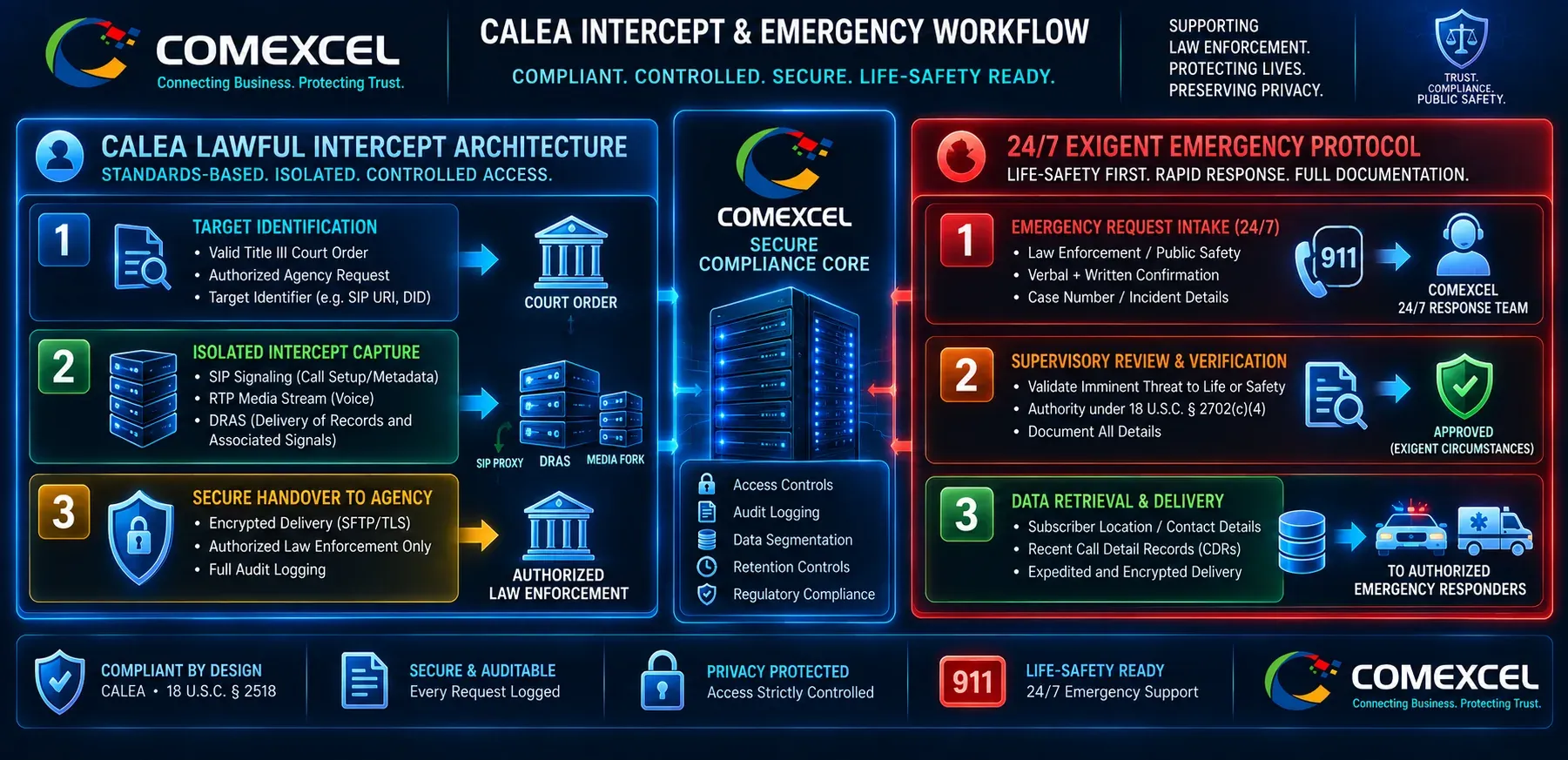
COMEXCEL maintains technical architectures compliant with the Communications Assistance for Law Enforcement Act (CALEA):
- Standardized Intercept Interfaces: Systems support industry-standard lawful interception protocols for real-time SIP signaling and RTP media stream isolation pursuant to valid Title III orders.
- Pen Register & Trap/Trace (PR/TT): Real-time dialing, routing, addressing, and signaling (DRAS) data capture under 18 U.S.C. § 3123.
- Separation of Content vs. Metadata: Metadata extraction and call content streams are strictly partitioned to ensure interception does not exceed authorized judicial scopes.
- Cryptographic Isolation: Technical feeds are provisioned exclusively through isolated, encrypted handover points directly to authorized law enforcement agencies.
Emergency Situations Involving Imminent Harm (Exigent Requests)
Under 18 U.S.C. § 2702(c)(4), COMEXCEL may voluntarily disclose customer records or metadata to law enforcement when we have a good-faith belief that an emergency involving imminent danger of death or serious physical injury to any person requires immediate disclosure.
Required Elements for Emergency Disclosures:
- Clear description of the exigent emergency involving imminent death or serious physical harm.
- The specific phone number(s), extension(s), or account identifier(s) involved.
- The specific data points requested to avert the immediate threat.
- Official law enforcement credentials, direct supervisor sign-off, and contact phone numbers for verification.
Emergency requests must be submitted using the formal Exigent Circumstances Intake Form and sent directly to [email protected] with “EMERGENCY – EXIGENT CIRCUMSTANCES” in the subject header.
Customer Notice & Gag Orders
- Default Policy (Notice Given): COMEXCEL’s policy is to notify account owners prior to disclosing account information to third parties or law enforcement, giving the subscriber an opportunity to seek protective relief or file a motion to quash.
- Statutory Non-Disclosure Orders: COMEXCEL will withhold customer notification only if served with a valid, non-expired judicial non-disclosure order issued under 18 U.S.C. § 2705(b) or applicable statutory sealing provisions.
- Delayed Notice: Once a non-disclosure order expires, COMEXCEL reserves the right to notify the customer unless a court of competent jurisdiction has formally extended the seal.
Data Retention, Preservation & Deprovisioning
- 18 U.S.C. § 2703(f) Preservation Requests: Formal requests to preserve existing subscriber records, CDRs, and communications metadata must be submitted in writing by authorized law enforcement agencies. COMEXCEL will preserve targeted records for ninety (90) days, renewable for an additional 90-day period upon official request.
- Alignment with Lifecycle Governance: Data not subject to a valid preservation hold is purged according to our Data Retention & Account Deletion Policy.
- Non-Creation of New Records: COMEXCEL is not obligated to generate, track, or maintain data logs that are not created during normal business operations.
Service of Legal Process & Submission Protocols
Electronic Service (Preferred):
Government and law enforcement agencies should transmit official legal process via secure transmission to:
- Standard Legal Process: [email protected]
Physical Service & Registered Agent:
Legal process may also be served during normal business hours on COMEXCEL’s registered corporate agent:
- Recipient: COMEXCEL Legal & Compliance Department
- Address: Registered Agent Office, COMEXCEL Inc.
Required Submission Information:
To avoid administrative delays, every legal process served must include:
- Full name, agency, badge number, official government email (.gov or .mil), and direct phone number of the requesting investigator.
- Complete case number, court title, and issuing magistrate signature.
- Precise identifying criteria (e.g., target telephone number in E.164 format, account ID, specific date/time range in UTC).
- Explicit identification of the specific statutory process invoked.
Cost Reimbursement Schedule
Pursuant to 18 U.S.C. § 2706 and applicable statutory authorities, COMEXCEL reserves the right to seek reimbursement for reasonable costs incurred while researching, locating, preserving, and producing requested records:
| Statutory Service Scope | Applicable Authority | Fee Schedule | Invoicing & Operational Terms |
|---|---|---|---|
| Basic Subscriber Records | 18 U.S.C. § 2706 | $75.00 flat fee per account | Account identity, billing records, IP history, and provisioned line lists. |
| Transactional CDR & Metadata Extraction | 18 U.S.C. § 2706 | $150.00 / hour (1-hour minimum) | Call Detail Records, SMS metadata extraction, and customized forensic queries. |
| CALEA Lawful Intercept Provisioning | CALEA / 18 U.S.C. § 2518 | Custom Engineering Fee | Scoped per authorized judicial duration, stream quantity, and routing architecture. |
| Expert Witness & Deposition Testimony | Statutory Deposition Rates | $250.00 / hour | Plus direct travel, administrative expenses, and specialized legal counsel fees. |
| Exigent Life-Safety Disclosures | 18 U.S.C. § 2702(c)(4) | $0.00 (No Charge) | Immediate triage for threats of imminent death or severe physical harm. |
Law Enforcement FAQ
What is COMEXCEL’s standard turnaround time for legal process?
Standard subpoenas and 2703(d) court orders are generally processed within ten (10) to fifteen (15) business days. Exigent life-safety requests are monitored 24/7/365 and evaluated immediately.
Can civil litigants obtain voice recordings or SMS message bodies?
No. Under the Stored Communications Act (18 U.S.C. § 2702), COMEXCEL is prohibited from disclosing the contents of communications to non-governmental entities in civil matters. Civil litigants must obtain communications content directly from the account owner or send a formal subpoena for non-content subscriber details.
Does COMEXCEL accept legal process from non-U.S. law enforcement agencies?
Foreign law enforcement requests must be submitted through the Mutual Legal Assistance Treaty (MLAT) process or Letters Rogatory handled by the U.S. Department of Justice (DOJ).
Where can I review platform encryption and security architecture?
For technical information regarding SIP signaling encryption, media transport, and data center controls, visit our Security & Trust Center.
Can COMEXCEL provide historical cell tower or real-time GPS location tracking?
No. COMEXCEL is an enterprise cloud telecommunications and VoIP service provider, not a wireless cellular carrier. We do not possess cell tower triangulation data, mobile GPS coordinates, or handset geo-tracking records. Emergency dispatchable location information is limited to subscriber-provisioned static E911 civic addresses.
How does COMEXCEL handle preservation letters under 18 U.S.C. § 2703(f)?
Upon receipt of a valid, written 2703(f) request from a government entity, COMEXCEL immediately preserves existing subscriber records and transactional logs for 90 calendar days. Agencies must submit an official written renewal prior to day 90 to extend preservation for an additional 90 days.
Law Enforcement & Regulatory Legal Notice Actions
Submitting Legal Process or Exigent Emergency Inquiries?
Authorized government agencies, court officers, and law enforcement investigators can submit subpoenas, search warrants, 2703(d) orders, and emergency life-safety disclosures directly to our dedicated legal processing team.